Instrumented balconied high-rise tower under ambient vibration survey

Precision instrument for structural dynamics

Every committed mode holds up under scrutiny.

Ambient data goes in; what comes out is a mode set an engineer can answer for. Each commitment arrives with a legible evidence trail, quantified uncertainty on the numbers that get contested, and acceptance thresholds cited to the literature that defines them. No other platform does all three.

0ENGINES Identification engines, frequency and time domain. 0ESTIMATORS Independent automatic damping estimators, cross-checked. σANALYTIC Analytic covariance on f, ζ, and φ. f₀SESAME Full HVSR site characterization in the box.
An automated mode you cannot interrogate is a mode no engineer will sign. Modal Master was drawn around one conviction: an answer is worth only as much as the evidence behind it — so every identification carries its own justification.

— The Modal Master design principle

01 — Engine Library

Nine identification engines.
One canonical mode set.

The complete frequency-domain family and the full stochastic subspace family, cross-checked against one another. Candidates from every method converge through a literature-cited commit gate into a single authoritative set of identified modes — the one source of truth that drives every downstream diagnostic and report.

FD · 01

FDD

Frequency Domain Decomposition — SVD of the cross-spectral matrix for clean, fast identification from ambient response.

Brincker · Zhang · Andersen
FD · 02

EFDD

Enhanced FDD — SDOF bell isolation and correlation-function decay for frequency and damping refinement.

Brincker · Ventura
FD · 03

FSDD

Frequency-Spatial Domain Decomposition — spatial filtering that sharpens close, weakly separated modes.

Zhang et al.
FD · 04

CFDD

Curve-fit FDD — parametric SDOF fitting in the frequency domain for an independent damping estimate.

Jacobsen · Andersen
FD · 05

AFDD Peak Wizard

Automated peak selection scored by modal coherence — guided identification that stays reviewable at every step.

Modal-coherence criterion
TD · 01

SSI-COV

Covariance-driven stochastic subspace identification with stabilization analysis and physical-pole discrimination.

Van Overschee · De Moor
TD · 02

SSI-DATA

Data-driven SSI via orthogonal projection — robust identification when covariance estimates run short.

Peeters · De Roeck
TD · 03

SSI-UPCX

Subspace identification with analytic covariance — first-order sensitivity propagation puts a standard deviation on every frequency, damping ratio, and shape.

Method family — Döhler · Mevel
TD · 04

NExT-ERA

Natural Excitation Technique with Eigensystem Realization — an independent time-domain cross-check on every SSI result.

James · Juang · Pappa

See the full engine library → — including TOMA (PSDTM-SVD), a research-badged evidence engine.

02 — The analysis bench

Beneath the engines,
a complete signal bench.

Identification is only as good as the spectra beneath it. Modal Master ships the whole bench: a universal-length FFT engine, seven interrogable spectral tools, an auditable conditioning pipeline, and channel screening that catches bad data before it becomes a bad mode.

THE TRANSFORM — HYBRID FFT

Any record length. Full length.

Field records rarely arrive in power-of-two lengths — and the Hybrid FFT engine never asks them to. It dispatches on the factorization of N: radix-2 and mixed-radix kernels, Good–Thomas prime-factor mapping, and Rader and Bluestein transforms for prime and stubborn lengths, selected by an explicit cost model. Your record is transformed at its native length — no truncation, no padding compromises.

  • Universal NPowers of two, smooth composites, primes, and everything between.
  • DispatchCost-model algorithm selection — and the decision itself is traceable.
  • SIMDVector-optimized kernels on the paths where they win.
VALIDATED LIKE EVERYTHING ELSE

An FFT that carries its own evidence.

The transform is held to the platform's standard: a 27-case golden regression suite of adversarial edge cases, 250 cross-validation checks across 113 sizes and algorithm paths, and accuracy verified from 64-point transforms through 2,097,152-point records — including a 2,097,143-point prime-length case that a power-of-two FFT cannot transform without altering the data.

Record length should never dictate analysis quality. That is why the transform is engineered — and tested — in-house.
Welch PSD · CSDAveraged auto- and cross-spectra with windowing, leakage, and power correction handled explicitly.
STFT spectrogramTime–frequency view of the record — see when the excitation changed, not just that it did.
CoherenceMagnitude-squared coherence between any channel pair — the classic noise-and-linearity screen.
CZT zoom · GoertzelChirp-Z band zoom and single-bin Goertzel probes for high-resolution inspection of narrow bands.
Burg AR spectrumParametric maximum-entropy spectrum with AIC order selection — resolution where averaging runs out.
Spectral statisticsDominant-frequency, energy, and dynamic-range descriptors for any selected channel.
Conditioning pipelineDetrending through polynomial order, zero-phase IIR filtering, and anti-aliased decimation — rebuilt deterministically, never compounded.
Harmonic line suppressionEvidence-gated detection, verification, and suppression of periodic lines before they poison damping.
Channel health screeningClipping, drift, dead spans, spikes, dropouts, SNR, and spectral kurtosis — graded before analysis starts.
Hilbert · CWT decayEnvelope and wavelet-ridge fits on a band-passed free-decay proxy — failed fits say so, with the reason.
ODSOperating deflection shapes on your geometry, with ODS spectrum and waterfall views.
Nonlinearity screenBicoherence-based quadratic-coupling assessment per mode — research-badged, like every maturity label in the app.
“What is this?” Every tool above explains itself. A built-in, bilingual engineering encyclopedia — 190+ concept articles with rendered mathematics, 160+ original figures, and cited references — bound to the exact control you are looking at.
“How was this calculated?” The numbers that end up in reports carry backend-computed calculation traces: the inputs, the formula applied, and the intermediate values, rendered as real mathematics.
03 — What no one else has

Three capabilities the rest of
the market cannot show you.

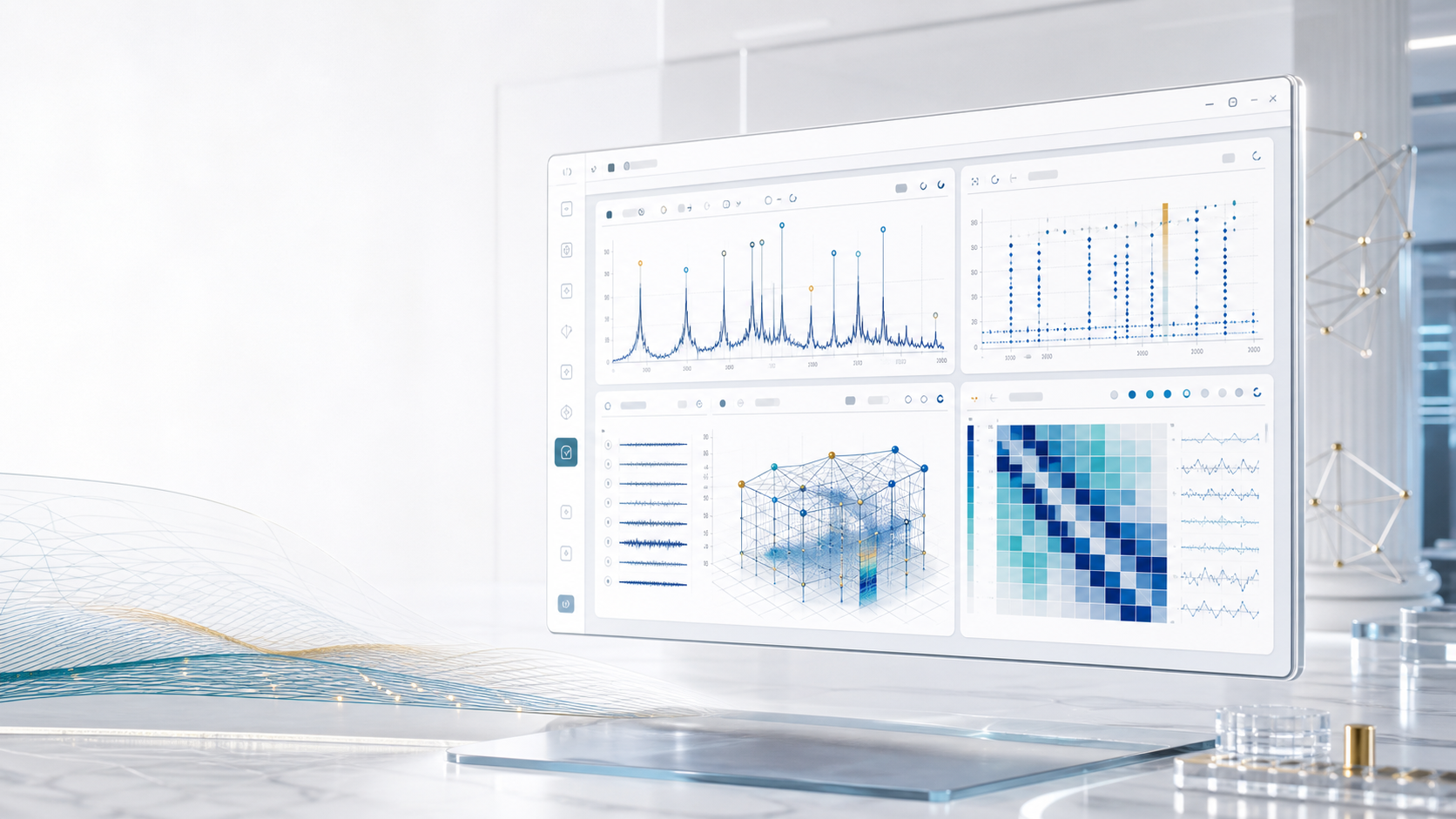
Modal Master analysis console with per-mode evidence panels
Deep Estimate — evidence console
I / EXPLAINABLE IDENTIFICATION

Automation that shows its work.

Deep Estimate does not cluster poles and hope. It works the way a senior analyst works: it perceives the signal character, diagnoses harmonics, low SNR, and close modes, plans a remediation, switches estimators when the data demands it, re-runs, and cross-validates across methods — committing only the modes that survive.

Behind every committed mode sits a decision log and a per-mode audit: which diagnostic fired, which gate it passed, the value against the threshold — and which paper defines that threshold.

Integrated suites automate as a black box. Scripting toolkits explain only to those who read code. No competitor pairs automated commitment with a legible, per-mode justification.
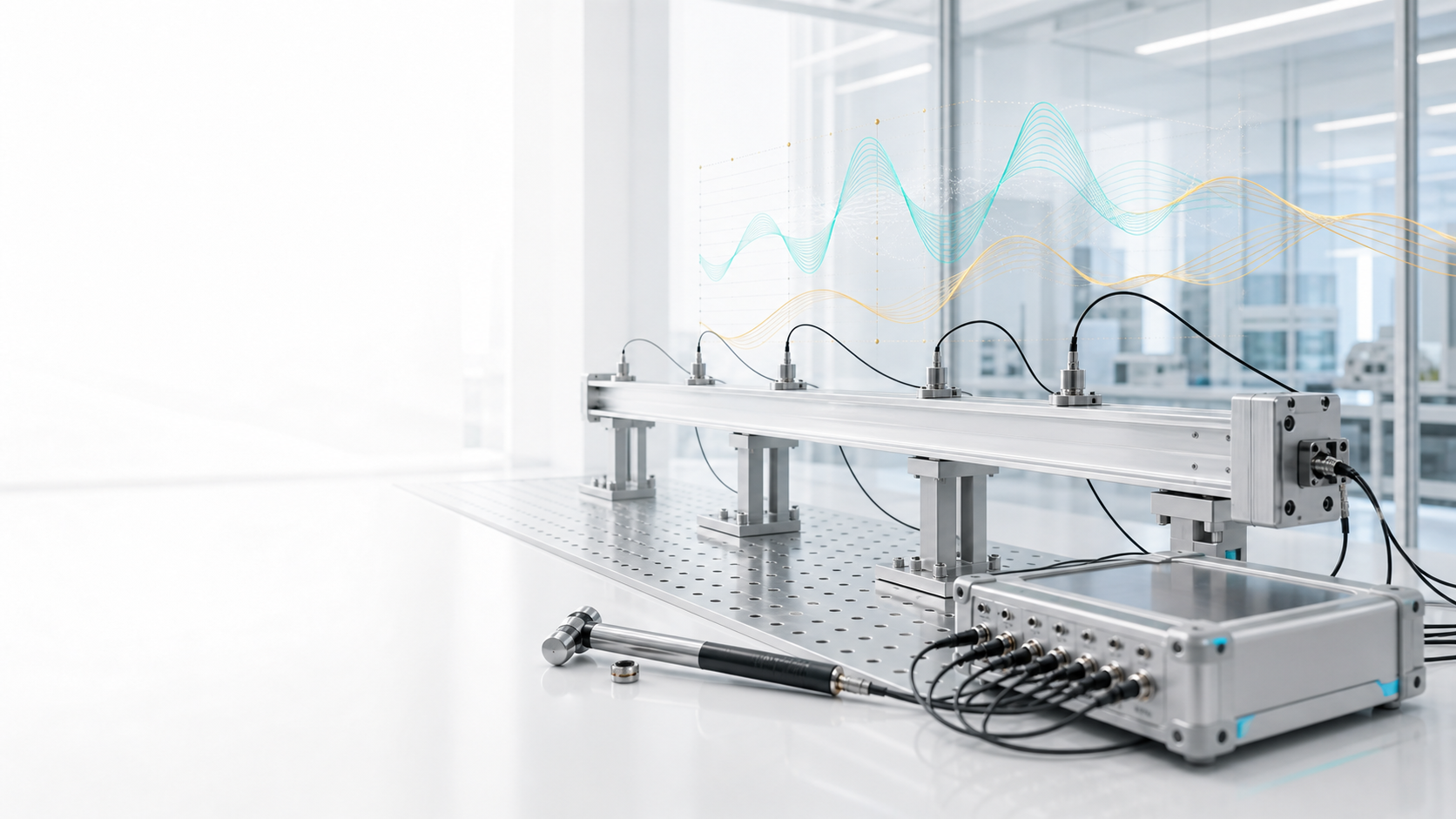
Calibration laboratory with reference instrumentation
Quantified confidence — SSI-UPCX
II / ANALYTIC UNCERTAINTY

A number, with error bars that mean something.

A frequency without a confidence interval is an opinion. Modal Master's SSI-UPCX engine propagates uncertainty analytically — first-order sensitivity propagation from the identified state-space model, closed by an exact analytic Jacobian on the conversion to frequency and damping — so every modal parameter arrives with its standard deviation attached.

  • σ (f)Frequency standard deviation, propagated analytically from the identified model.
  • σ (ζ)Damping-ratio confidence bands where decisions actually get contested.
  • σ (φ)Shape uncertainty that flows into MAC and downstream validation.
Quantified confidence on every UPCX mode — surfaced on the mode card, carried into the evidence trail, and printed in the report. Most of the commercial field shows you none of it.
Heritage structure under ambient vibration survey
Site & structure — HVSR / SESAME
III / SEISMIC SITE CHARACTERIZATION

The OMA suite that also reads the ground.

Modal Master ships a complete HVSR workflow — SESAME reliability and clarity criteria, directional HVSR, f₀ stability analysis, SAF import and export — alongside strong-motion record support. Structure and site, in one instrument, for the earthquake-engineering work the mechanical-vibration incumbents do not serve.

  • SESAMEFull criteria evaluation on every H/V curve — pass and fail, itemized.
  • f₀Fundamental-frequency stability across time windows and azimuths.
  • .V2 / .SMCStrong-motion formats ingested natively, next to your ambient data.
None of the major integrated OMA suites ships HVSR. This is white space — and it is already in the box. Explore site characterization →
04 — The Deep Estimate loop

It iterates like an engineer.
Deterministically.

The world's first closed-loop Automatic Mode Estimation engine: it diagnoses its own results, switches methods, re-runs the identification, and reverts any step that degrades the evidence — logging every decision. The same record always produces the same modes, the same decisions, and the same log.

STEP 1PerceiveCharacterize the record: stationarity, SNR, spectral content, harmonic risk.
STEP 2DiagnoseDetect rotating-machinery harmonics, close modes, weak excitation, aliasing exposure.
STEP 3PlanChoose the remediation: switch SSI variant, adjust model order, re-window, notch.
STEP 4Re-identifyExecute the plan and re-run identification with the adapted strategy.
STEP 5Cross-validateConfirm across independent methods; commit only the modes that survive the gates.

Based on published capabilities of commercial OMA/EMA software and peer-reviewed literature as of July 2026. Substantiation dossier available on request.

05 — Validation battery

Every mode interrogated
from every angle.

Identification is half the discipline. Modal Master subjects every candidate to a battery of quality, correlation, and complexity diagnostics — and up to four independent automatic damping estimators cross-checked against the committed value, with disagreement made visible.

MACModal Assurance Criterion matrices across the full identified set.
CrossMACCross-method shape correlation — FDD against SSI against NExT-ERA.
MPC · MPDModal phase collinearity and mean phase deviation for complexity screening.
StabilizationMulti-order stabilization diagrams with physical-pole classification.
Damping cross-checkHalf-power bandwidth, CFDD fit, Hilbert envelope, and CWT — four independent estimators; the committed value never votes on itself.
Harmonic screeningSpectral-kurtosis detection protects damping from rotating-machinery contamination.
Aliasing riskPer-mode aliasing exposure assessed against the acquisition chain.
Mode qualityComposite quality indices so review effort lands where doubt is highest.
06 — The per-mode evidence trail

Every commit carries
its own defense.

A committed mode is not a row in a table. It is a decision, and every decision is backed by the diagnostic that fired, the value it produced, the gate it cleared, and the citation that sets the bar.

DIAGNOSTIC

Which check fired

Each mode records the diagnostics that ran against it — stabilization, harmonic screen, complexity, correlation — and the order at which it settled.

stabilized ⋅ order 34
THRESHOLD

Value against the bar

The measured quantity is printed next to the acceptance threshold, so a reviewer sees the margin, not just a verdict.

MAC 0.981 ≥ 0.90
UNCERTAINTY

σ on the number

Analytic covariance attaches a standard deviation to the frequency and damping ratio — the confidence interval travels with the mode.

f = 2.7555 ± 0.0031 Hz
CITATION

Who set the threshold

Every gate names the peer-reviewed source that defines it, so the defense of a mode points to the literature, not to a preference.

Reynders et al.
CROSS-METHOD

Agreement across engines

A mode confirmed by FDD, SSI, and NExT-ERA carries its cross-method correlation, so independent agreement is visible at a glance.

CrossMAC 0.96 ⋅ 3 engines
PROVENANCE

Reproducible by construction

The same record and the same settings reproduce the same commit and the same log — a deterministic trail that survives review and dispute.

deterministic ⋅ logged
07 — Where we stand

Measured against the field.
Honestly.

We publish the comparison others imply. On the axes that decide whether a result can be defended — identification depth, explainability, uncertainty, damping rigor, site characterization, and reporting — this is the state of the market. Each scale refills as you read it.

Capability Modal Master Integrated DAQ suites Open-source toolkits
Frequency-domain OMA family (FDD · EFDD · FSDD · CFDD)
category-leading
competitive
competitive
Stochastic subspace family (COV · DATA · UPCX)
category-leading
category-leading
competitive
Automated identification with explainable, per-mode trust
category-leading
competitive
limited
Analytic modal uncertainty (σ on f, ζ, φ)
category-leading
limited
limited
Damping cross-validation (4 independent automatic estimators)
category-leading
competitive
limited
HVSR / SESAME site characterization
category-leading
absent
absent
Report-grade branded deliverables
category-leading
competitive
limited

Composite assessment against the published capabilities of leading integrated OMA suites and open-source OMA toolkits, July 2026. Scales are indicative: category-leading · competitive · limited · absent. Detailed methodology available under NDA with a technical evaluation.

08 — The workflow

From raw record to signed report.
One traceable line.

01

Import

Bring in the data exactly as it was acquired — no silent resampling, no overridden metadata. What the instrument recorded is what the analysis sees.

NI TDMSCSV · TXTXLSX.V2 · .V2C · .SMCSAF
02

Condition

Detrend, filter, decimate, and window with full preview — every operation parameterized, logged, and reversible before it touches the estimate.

FilteringDecimationSpectrogramSTFT
03

Identify

Run any engine directly, or hand the record to Deep Estimate and watch it diagnose, adapt, and converge — with every decision logged as it happens.

FDD familySSI familyNExT-ERADeep Estimate
04

Validate

Interrogate candidates with the full diagnostic battery — correlation, complexity, damping cross-checks, harmonic screening, and analytic uncertainty.

MAC · CrossMACMPC · MPDσ bandsHarmonics
05

Commit

Accepted modes pass the cited commit gate into a single canonical mode set — the one source of truth every downstream computation reads from.

Evidence trailDecision logCanonical modes
06

Report & visualize

Animated 3D mode shapes and operating deflection shapes on your real geometry — imported from SAP2000 and ETABS models — flowing into branded, review-ready reports.

3D mode shapesODS animation.S2K · .E2KBranded reports
09 — In the field

One instrument, across the
structures that carry people.

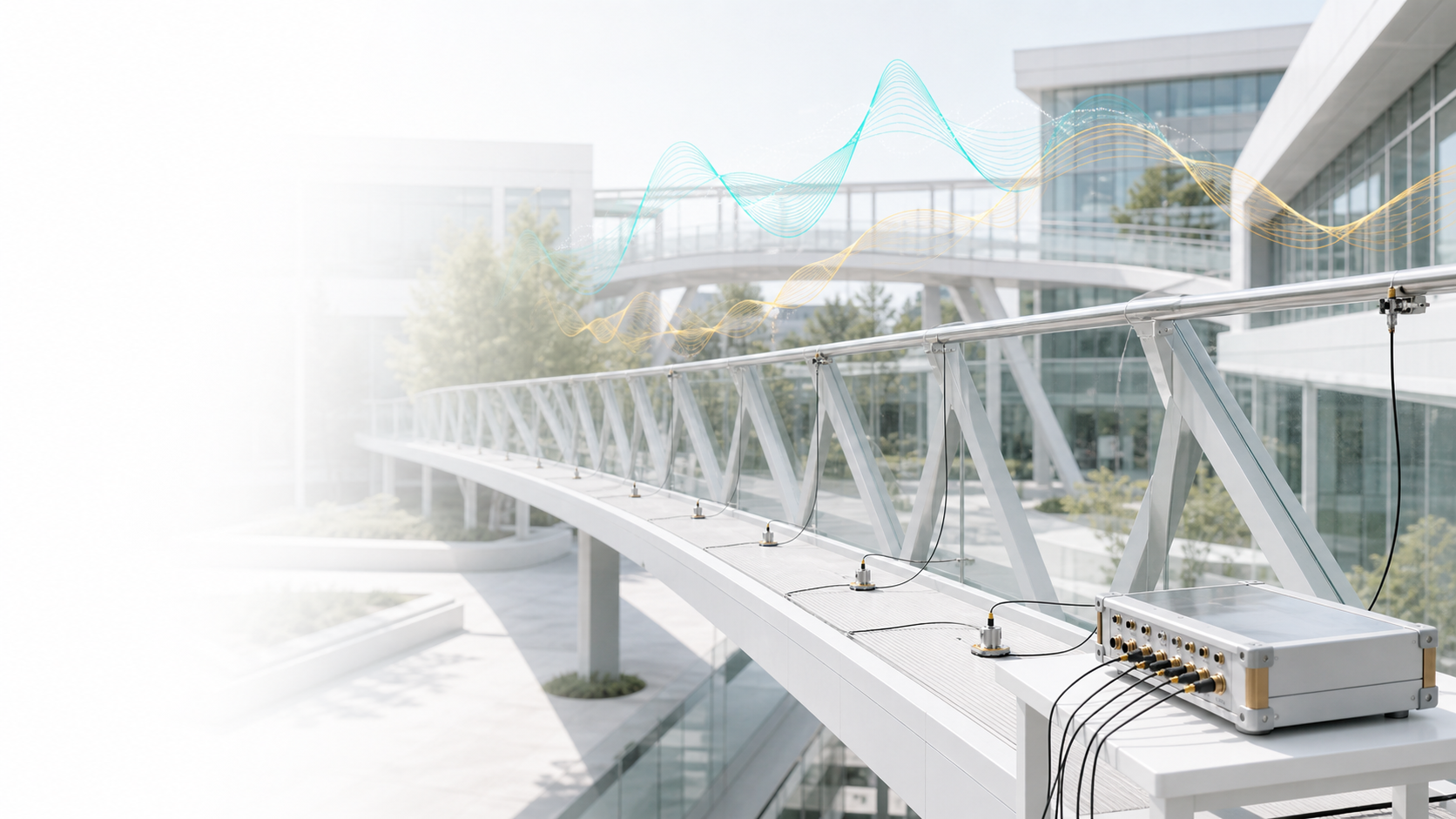
Instrumented campus footbridge
Bridges & viaductsAmbient identification
High-rise serviceability assessment
High-rise serviceabilitySway & comfort
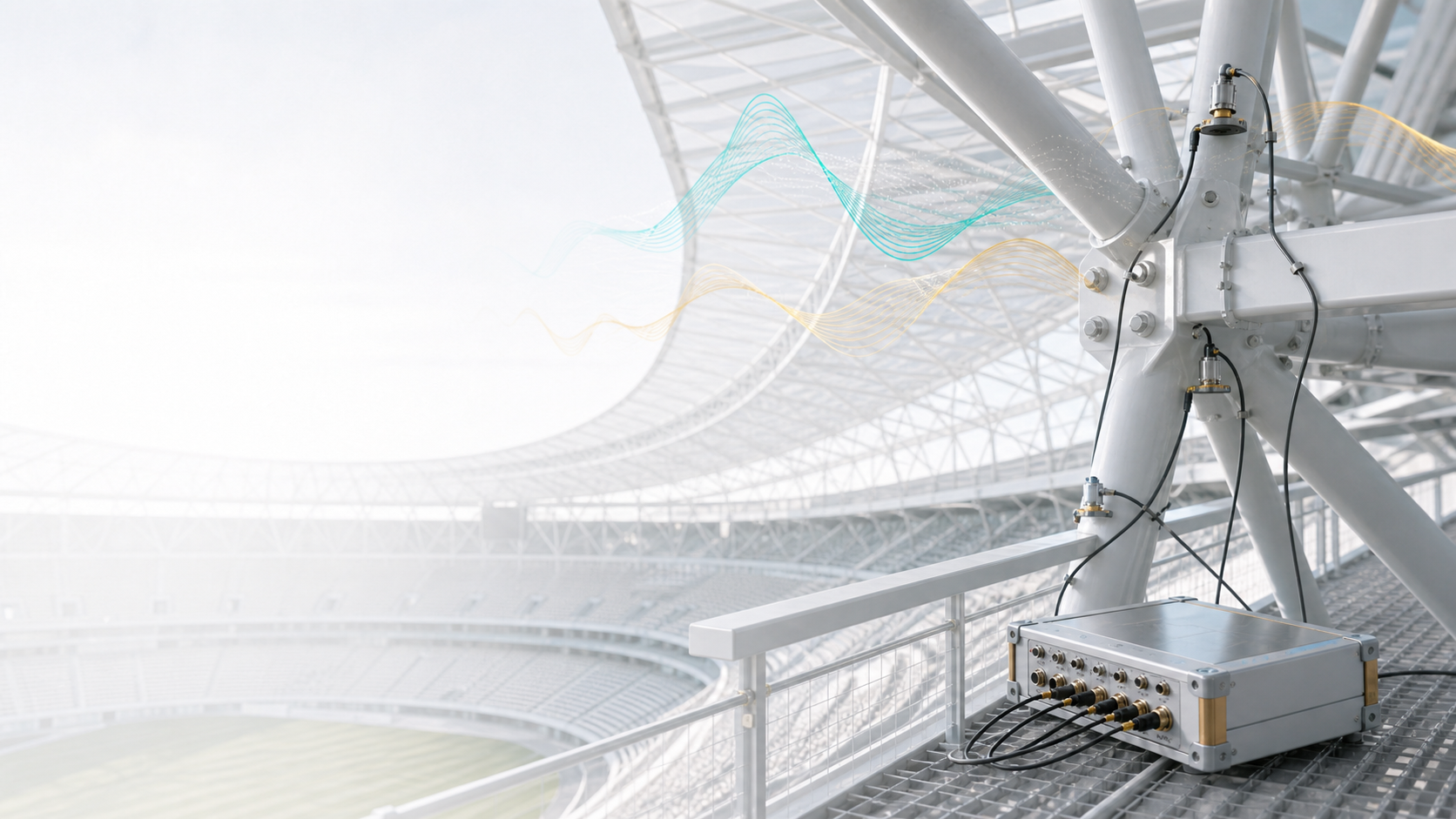
Stadium roof dynamics
Stadium & long-span roofsLow-frequency modes
Heritage structure survey
Heritage structuresHVSR & site studies
10 — Built for the enterprise

Engineered for organizations
that cannot afford to be wrong.

Your data never leaves the building

A native desktop instrument, on-premises by design. No cloud dependency, no telemetry of your measurement data, no third party between you and your results.

Defensible by construction

Deterministic engines, logged decisions, and thresholds cited to peer-reviewed literature — deliverables built to survive technical review, client scrutiny, and dispute.

Report-grade output

Branded, structured engineering reports generated directly from the committed evidence — not screenshots assembled after the fact.

Licensing that fits procurement

Online first activation, signed seven-day leases with temporary offline use, one active device per licence, and terms designed for engineering organizations rather than app stores.

Fully bilingual

Complete English and Turkish interfaces — engineered as a first-class localization, not an afterthought translation.

Direct engineering support

Priority support from the engineers who build the algorithms — with the literature open on the desk.

11 — Editions & add-ons

Choose the edition that fits
the work you need to defend.

Annual, one-seat licensing. Core, Pro, and Ultimate use the same production application and the same signed online-licensing flow.

Essential OMA

Modal Master Core

€2,900 / year

Core frequency-domain OMA, validation, and reporting tools.

  • FDD and EFDD
  • SSI-COV with stabilization diagrams
  • MAC, AutoMAC, CrossMAC, and COMAC
  • Peak quality and harmonic checks
  • 3D mode visualization
  • HVSR site characterization
Buy Now
Complete edition

Modal Master Ultimate

€11,900 / year

The complete OMA edition with four advanced capabilities included.

  • All Pro features
  • Deep Estimate
  • Bayesian Identification
  • Stationarity & Event Analysis
  • Physical Mode Scaling
  • Batch Runner and FE Correlation remain separate
Buy Now
Individual add-ons

Add capabilities to Pro or Ultimate

Core customers cannot purchase add-ons. Ultimate already includes the first four capabilities; Batch Runner and FE Correlation remain separate.

Choose add-ons above, then use the Pro or Ultimate Buy Now button. Add-ons are annual and follow the edition subscription term.

Verified academic pricing is 40% below commercial pricing and cannot be combined with another offer. Paddle checkout completion alone does not activate the software; access begins only after the verified webhook creates the entitlement and the activation email is issued.

Private demonstration

Commit a mode set that
answers for itself.

Bring your own ambient record. In ninety seconds you will watch Modal Master identify, diagnose, cross-validate, and justify a committed mode set — with the evidence trail open — in a way no other platform on the market can reproduce.

Enterprise evaluations · Technical dossiers under NDA · Volume licensing

Request a demo