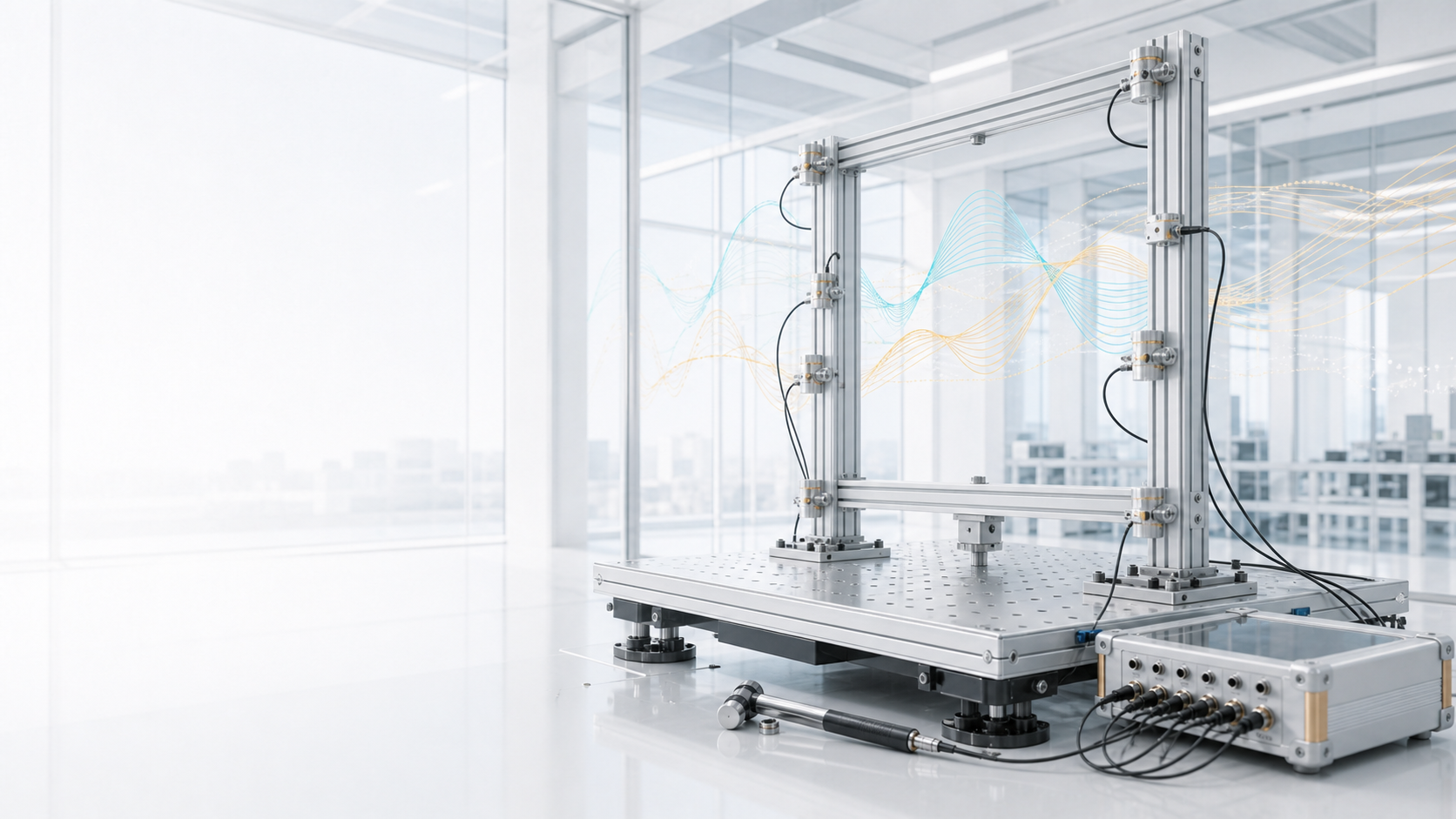
Instrumented laboratory test frame under modal survey

The engine library

Nine identification engines.
One canonical mode set.

The complete frequency-domain family and the full stochastic subspace family, cross-checked against one another and arbitrated through a literature-cited commit gate into one canonical set of identified modes.

0FD Frequency-domain engines, FDD through the AFDD wizard. 0TD Time-domain engines: three SSI variants and NExT-ERA. 0SPECTRUM Interrogable spectral tools on the bench beneath the engines. 0GATE One commit gate; one authoritative set of identified modes.
01 — Frequency domain

The FDD family, complete.

From the classic singular-value decomposition of the cross-spectral matrix to spatial filtering for close modes, parametric curve fitting for damping, and a peak wizard that scores candidates by modal coherence — every branch of the frequency-domain literature, in one instrument.

FD · 01

FDD

Frequency Domain Decomposition — SVD of the cross-spectral matrix for clean, fast identification from ambient response. The reference method the family is built on.

Brincker · Zhang · Andersen
FD · 02

EFDD

Enhanced FDD — SDOF bell isolation around each peak and correlation-function decay for refined frequency and damping estimates.

Brincker · Ventura
FD · 03

FSDD

Frequency-Spatial Domain Decomposition — spatial filtering that sharpens close, weakly separated modes where plain FDD blurs them together.

Zhang et al.
FD · 04

CFDD

Curve-fit FDD — parametric SDOF fitting in the frequency domain, contributing an independent damping estimate to the cross-check battery.

Jacobsen · Andersen
FD · 05

AFDD Peak Wizard

Automated peak selection scored by modal coherence — guided identification that proposes, explains, and stays reviewable at every step.

Modal-coherence criterion
02 — Time domain

The subspace family,
with uncertainty attached.

Covariance-driven and data-driven stochastic subspace identification with stabilization analysis and physical-pole discrimination — and a UPCX variant that puts analytic standard deviations on every parameter. NExT-ERA stands apart as an independent time-domain cross-check.

TD · 01

SSI-COV

Covariance-driven stochastic subspace identification — multi-order stabilization analysis with physical-pole discrimination, the workhorse of ambient identification.

Van Overschee · De Moor
TD · 02

SSI-DATA

Data-driven SSI via orthogonal projection of the raw data matrix — robust identification when covariance estimates run short on record length.

Peeters · De Roeck
TD · 03

SSI-UPCX

Subspace identification with analytic covariance — first-order sensitivity propagation from the identified state-space model puts a standard deviation on every frequency, damping ratio, and mode shape.

Method family — Döhler · Mevel
TD · 04

NExT-ERA

Natural Excitation Technique with Eigensystem Realization — a genuinely independent time-domain estimate, used to cross-examine every SSI result rather than echo it.

James · Juang · Pappa

Every engine reads from the same measured bench — Welch spectra, coherence, zoom transforms, and a universal-length Hybrid FFT. See the analysis bench →

03 — Research instrument

And one research engine,
badged as exactly that.

TOMA (PSDTM-SVD) Research-badged and evidence-only: identification from the singular values of the power-spectral-density transmissibility matrix — a mathematical route independent of both FDD and SSI. Its candidate table corroborates review; it never commits modes.
Real-data gate Badged after clearing a three-structure replication gate on recorded ambient data (July 2026): archived protocol, hashed inputs, byte-identical candidate tables across independent runs.
Nine engines produce candidates. One gate decides. Candidates converge through a literature-cited commit gate into a single canonical mode set — and when a mode is removed, every downstream diagnostic recalculates. No stale results, no orphaned conclusions.

— One source of truth, enforced by architecture

04 — Validation battery

Every candidate interrogated
from every angle.

Between the engines and the commit gate stands the battery: quality, correlation, complexity, and contamination diagnostics that every candidate must face before it can become a committed mode.

MACModal Assurance Criterion matrices across the full identified set.
CrossMACCross-method shape correlation — FDD against SSI against NExT-ERA.
MPC · MPDModal phase collinearity and mean phase deviation for complexity screening.
StabilizationMulti-order stabilization diagrams with physical-pole classification.
Harmonic screeningSpectral-kurtosis detection protects damping from rotating-machinery contamination.
Aliasing riskPer-mode aliasing exposure assessed against the acquisition chain.
Mode qualityComposite quality indices so review effort lands where doubt is highest.
σ bandsAnalytic uncertainty from SSI-UPCX carried through MAC and downstream checks.
05 — Damping cross-validation

Four independent judges.
No self-confirmation.

Every committed damping ratio is cross-examined by up to four automatic estimators from two bias families: half-power bandwidth, CFDD curve fit, Hilbert envelope decay, and continuous wavelet transform. The estimator that produced the committed value is deliberately excluded from its own cross-check — so when the judges agree, the agreement is real. Disagreement is displayed, not averaged away. How the consensus works →

Private demonstration

Run the full library
on your record.

Bring your own ambient data and watch the library cross-examine itself — candidates, diagnostics, arbitration, and the committed set, with the evidence trail open.

Enterprise evaluations · Technical dossiers under NDA · Volume licensing

Request a demo